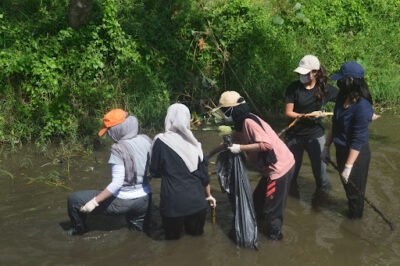
Malang students work together to collect trash in the Tunggulwulung River
(Source: Personal Documentation, 2026)
MALANG — A total of 39 students from various universities across Malang took to the banks of the Tunggulwulung River on Sunday (7/6/2026), joining hands to clean up waste as part of COLLPAIGN 2026 — organized by IAAS LC Universitas Brawijaya, a non-profit student organization focused on the study of agriculture and related sciences.
As one of the annual programs of the Public Relations and Partnership (PRP) Department of IAAS LC UB, COLLPAIGN 2026 stands as a concrete commitment by the younger generation toward the preservation of water resources. The program was carried out through two approaches: online and offline educational campaigns, followed by a direct river-cleaning action at Tunggulwulung River.
The event on Sunday (7/6/2026) began with participant registration at the Raden Wijaya Gazebo, Universitas Brawijaya, where attendees filled in attendance sheets and received river-cleaning equipment including rubber boots. Once registration was complete, participants were directed to board a coordinated angkot (public minivan) to the main venue at the Community Hall of Tunggulwulung Village.
Upon arrival, the program continued with a series of opening remarks delivered by the IAAS LC UB supervisor, the Local Committee Director of IAAS LC UB, and the Field Coordinator of COLLPAIGN 2026, Husein Fadlullah. In his remarks, Husein emphasized that the action was meant to go beyond physical impact. “Through this activity, I hope we not only clean up the environment physically, but also cultivate a shared awareness of the importance of keeping our rivers clean and disposing of waste properly,” he said.
The event continued with a material briefing session delivered by Aunul Haqqi Adlani, Chairperson of the Water Engineering Student Association at Universitas Brawijaya. In his presentation, Haqqi explained that waste accumulation in rivers not only damages aquatic ecosystems but also significantly reduces the soil’s water absorption capacity. “River restoration is not just about removing visible waste — it is about fully rehabilitating the water quality and ecosystem affected by pollution,” he asserted. The session was followed by an open discussion between the speaker and participants on the importance of protecting rivers from the threat of waste contamination.
Moving into the main activity, participants were divided into several groups and equipped with personal protective equipment — including latex gloves, rubber boots, and masks — before entering the river. During the cleanup, participants collected a wide variety of waste, including used fabric, tree branches, and plastic rubbish polluting the river. In addition to physically removing waste, participants were also given the opportunity to pour Ecoenzyme into the river as a small but meaningful contribution to breaking down microscopic pollutants invisible to the naked eye.
One of the participants, Keira Ramadhani, a student from Universitas Brawijaya, shared that the experience of getting directly into the river was far more impactful than receiving education in a classroom setting. “We didn’t just get education about the importance of protecting the environment — we also got to dive in and clean the river ourselves. This activity made all of us more aware that keeping our environment clean is a shared responsibility,” she said. The event also drew the presence of residents living near Tunggulwulung River, further enriching the community spirit of the activity.
The COLLPAIGN 2026 program concluded with a break for rest, prayer, and a communal meal (ishoma), followed by closing reflections from participant representatives and a group documentation session involving all committee members and participants.
Looking ahead, IAAS LC UB plans to continue the COLLPAIGN program annually with an expanded reach to a wider range of locations, while actively encouraging communities living near rivers to take part in the long-term monitoring of waterway cleanliness and sustainability.
Writer: Jessica Kusuma Rayani
Credit: IAAS LC UB