
Utilization of Coffee Husk Waste as Versatile Bioplastic

Coffee Husk | Global Coffee Report
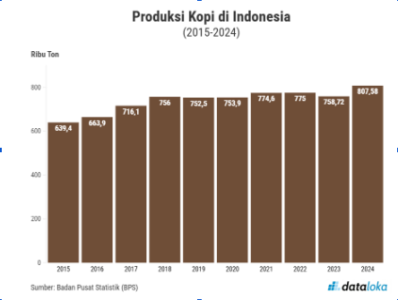
Have you realized, Fams? Coffee has become part of our lives no matter where we are. In the workplace, in the world of education, even when we relax, coffee is always somewhere nearby, whether as a drink or as food. That is not surprising, because Indonesia has actually become the fourth largest coffee producer in the world, with national production reaching 813,350 tons in 2024 according to data from the Central Statistics Agency (BPS). Indonesia can be said to be the world’s fourth largest coffee producer, and this matches national coffee consumption which reached 288,000 tons in the 2024 to 2025 period (Salma, 2025).
National Coffee Production | Data Loka
This massive presence of coffee is not only supported by production numbers but also by the huge number of outlets spread across the country. According to Kurniawan et al. (2026), the recorded outlets number around 10,000 spread throughout Indonesia. That number does not even include street vendors who do not operate from a fixed stall. No wonder coffee feels so deeply attached to Fams, even for those who do not particularly like it.
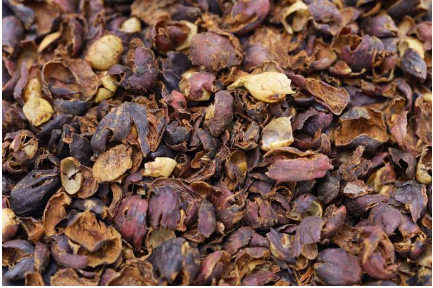
This achievement should not be celebrated too quickly. As the fourth largest producer in the world, Fams needs to look at the bigger picture. Production always creates something, and that something is called waste. If Fams pays attention, coffee has a fairly unique structure. According to Rosidah et al. (2021), on average 40 to 45 percent of the weight of harvested coffee fruit is coffee skin, which ends up simply becoming waste. In other words, almost half of the coffee fruit is discarded without ever being used. To an ordinary person this might seem like a minor issue, but once you look deeper into the raw numbers, the amount of waste reaches around 366,007.5 tons, equivalent to stacking seven Borobudur temples, and this happens every single year.
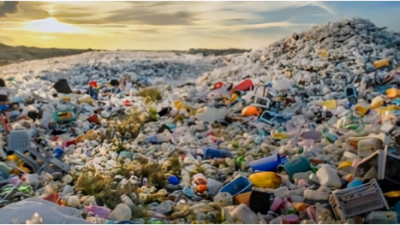
Looking at those numbers is probably a bit shocking, especially once you realize that this is only one of many waste problems in Indonesia. There is another equally complicated issue, and Fams surely knows it already, plastic. Something we use every day, whether we realize it or not, has already become a massive problem. Without us fully noticing, we have generated plastic waste amounting to 5.15 million tons, or 20.49 percent of the total national waste, according to data from the Ministry of Environment and Forestry (KLHK, 2025) through the National Waste Management Information System (SIPSN).
Environmental Damage Caused By Plastic Waste | DLH Buleleng
Seeing both of these problems can feel endless and honestly a bit dizzying, but here is the thing. If Fams looks closely, the two issues are actually closely connected. Coffee skin waste is organic material, and organic material can decompose naturally, and that is exactly where the answer lies. Plastic keeps piling up and is hard to break down, while on the other side coffee skin waste sits unused. From this contrast comes an idea to create an innovation where the two problems complement and solve each other.
This idea is supported by the content found inside coffee skin. According to Nguyen et al. (2023), coffee skin contains lignocellulose, made up of 39.2 percent cellulose, 12.6 percent hemicellulose, and a total lignin content of 26.2 percent. Based on research by Habibi (2023), bioplastic is able to decompose because its main materials are starch, cellulose, and lignin. Those exact components are present in the structural composition of coffee skin waste, which shows real promise for developing it into a base material for biodegradable bioplastic that supports the creation of environmentally friendly packaging biomaterials.
Comparisons of decomposition rates also show a positive picture. Research by Galaviz Villa et al. (2025) proved that cellulose based biopolymer from coffee skin degraded up to 84.4 percent within 110 days, far faster compared to conventional plastic which needs anywhere from 58 to 1,200 years to break down in nature (Ward et al., 2019). This data shows that in terms of environmental impact, bioplastic is much safer because it can decompose hundreds to thousands of times faster than conventional plastic, which takes a lifetime spanning hundreds of generations. In addition, from a health standpoint, microplastics from conventional plastic are toxic to the body because the body recognizes them as harmful substances, while bioplastic does not carry this risk since its materials are safe and are things Fams are already used to consuming.
Plastic and coffee are two things that are often present around Fams, even though many of us never really notice it. Both have their own problems, and at first glance they seem unrelated, even completely different from one another. That perception changes once we look through the lens of science. The two are actually connected and closely tied together. Through addressing environmental issues and material needs, coffee skin waste becomes one solution for raw material availability in making bioplastic, replacing conventional plastic which comes with a long list of problems of its own. (MUAS)
Author : Muhamad Aqil Syafiq
References:
Galaviz-Villa, I., Pérez-Landa, I. D., Sampieri, G. D. G., Alcántara-Méndez, V., Salcedo-Garduño, M. G., & Castillo-Ferat, M. A. (2025). Biodegradable Polymers Based on Cellulose and Fiber from Coffee (Coffea spp.) and Sugarcane (Saccharum spp.) Residues. BioResources, 20(3).
Habibi, M. W. (2023). Inovasi bioplastik bahan dasar batang pisang kepok ramah lingkungan. Jurnal Penelitian Biologi dan Terapannya (Biosense), 6(02), 282–295.
Kementerian Lingkungan Hidup dan Kehutanan. (2025). Sistem Informasi Pengelolaan Sampah Nasional (SIPSN).
Kurniawan, E. N., Syafari, A. H., Awalia, M., & Siregar, H. (2026). Peluang, Tantangan, Dan Masa Depan Ukm Coffee shop Kopi. US. JPPI: Jurnal Pengabdian Pelita Insani, 3(01).
Maheswara, R. (2025, July 22). Produksi Kopi Indonesia 2024 Tembus 807 Ribu Ton, Tertinggi dalam 10 Tahun. Dataloka.id. Retrieved September 5, 2026, from https://dataloka.id/ekonomi/4307/produksi-kopi-indonesia-2024-tembus-807-ribu-ton-tertinggi-dalam-10-tahun/
Rosidah, U., Sugito, S., Yuliati, K., Abdiansyah, A., & Anggraini, F. (2021). Identifikasi Senyawa Fitokimia dan Aktivitas Antioksidan Minuman Fungsional Cascara dari Kulit Kopi dengan Fermentasi Terkendali. Sustainable Urban Farming Guna Meningkatkan Kesejahteraan Masyarakat Di Era Pandemi, 611–620.
Salma Adinda, H. (2025). Perbedaan Efek Pemberian Kopi Robusta Dan Arabika Lampung Terhadap Gambaran Histologi Arteri Koronaria Tikus Putih (Rattus Norvegicus) Jantan Galur Sprague Dawley.
Van Nguyen, D., Duong, C. T. T., Vu, C. N. M., Nguyen, H. M., Pham, T. T., Tran-Thuy, T. M., & Nguyen, L. Q. (2023). Data on chemical composition of coffee husks and lignin microparticles as their extracted product. Data in Brief, 51, 109781.
Ward, C. P., Armstrong, C. J., Walsh, A. N., Jackson, J. H., & Reddy, C. M. (2019). Sunlight converts polystyrene to carbon dioxide and dissolved organic carbon. Environmental science & technology letters, 6(11), 669-674.