
From Museum to Dining Table: Approach of Reviving The Local Food

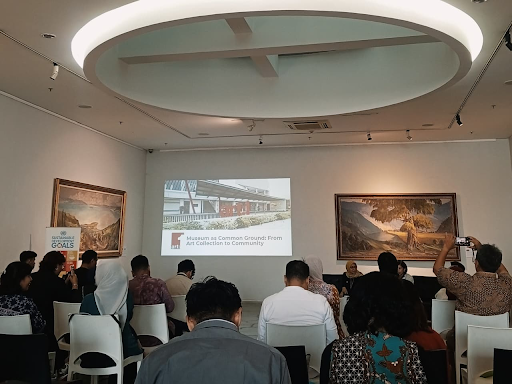
MSDG Series 1 | Personal Documentation
Let’s dive IAAS-ers to this fresh topic!
The author had the opportunity to attend the MSDG Talk Show Series 1: “Museum untuk Kualitas Hidup: Inklusi dan Kesejahteraan Masyarakat” held on August 28, 2026, at the ART 1 Museum in Jakarta. This forum brought together various stakeholders from diverse backgrounds and areas of expertise to discuss how museums could play a broader role in the lives of the community. One perspective that caught the author’s attention is the involvement of the United Nations Food and Agriculture Organization (FAO) Indonesia in this forum. The FAO’s presence at a forum typically focused on the museum world raises an intriguing question: What’s the connection between museums and food? And could the museums play a role in building food security?
One of the ideas presented at the forum was the connection between Zero hunger as Sustainable Development Goal 2 (SDGs 2) and the role of museums. Museums not only act as storage places for historical objects but can also play the role of sharing information, creating awareness, and arousing the curiosity of locals regarding the local food. Educational processes that will be based on the local food will contribute to better food literacy and will bring about behavioral changes in consumers. As consumers gain more understanding regarding the history, culture, ways of cultivation, and cooking of the food, their curiosity will grow and can result in market demand. In the end, it will act as motivation for farmers to cultivate their goods once again.
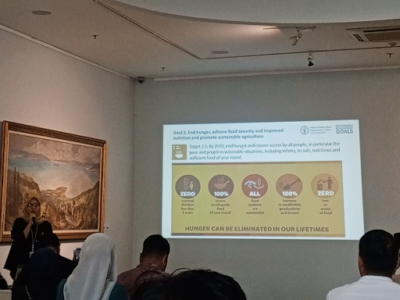
Explanation of SDGs 2 by FAO Representative | Personal Documentation
The concept assumes even greater significance in light of the present situation in relation to agricultural biodiversity or agrobiodiversity. FAO stresses the fact that biodiversity is the basis of any sustainable food and agriculture system. The problems associated with modern food systems are multi-dimensional, including environmental degradation and loss of biodiversity. It calls for innovation based on local biodiversity in order to create food systems that are resilient. FAO observes that there are only three crops, which are rice, maize, and wheat, that provide about half of all plant-based calories eaten worldwide. This clearly indicates that maintaining local sources of food is important not only as a way of keeping up with culinary traditions but also as part of creating a diversified food system.
In this context, museums can be seen as a new approach towards food security in a unique way. Museums of the current age have changed from mere exhibition places to become social institutions and change agents utilizing immersive experience for engaging the people in the difficult questions about food systems. Museums can display local food not just as things that are being exhibited, but as a story that involves seeds, land, farmers, farming practices, and community wisdom, up to the food that is put on the table.
What would be like an exhibition of Papuan sago, of local varieties of rice, of local fruits, of spices, or food plants that become increasingly hard to find? Visitors do not simply view the physical specimens, but they also gain an understanding of who cultivates them, how they grow, their nutritional value, how communities process them, and why their preservation is vital. This type of approach aligns with the practices of the FAO itself. In 2026, the FAO Museum and Network (MuNE) is presenting an immersive experience centered on Globally Important Agricultural Heritage Systems (GIAHS), highlighting agricultural landscapes, biodiversity, traditional knowledge, and community life as integral parts of a living agricultural heritage.
The conservation of local food does not have to be limited to the museum setting. Museums could act as the beginning where the connection between knowledge and action can take place. While museums might not grow plants nor make food, there is an area where they can play an equally significant role, such as cultivation of knowledge, curiosity, and appreciation. Museums are not necessarily places where one could go to learn about the history and remember the past, yet they can also become places where one could revive some things that have been all but forgotten. The local foods that used to belong to people’s lives can be rediscovered by the younger generation. Not just as objects of history but as foods that could be grown, eaten, and shared around the dinner table again. (DUY)
Author: Rizky Dwi Cahyani
References:
Borrelli, N., Koch, P., & Burgos Guerrero, S. (2026). Working in the Middle: Museums Spurring Food Governance Sustainable Transition in NYC. The International Journal of Sociology of Agriculture and Food, 32(1), 27-50. https://doi.org/10.48416/ijsaf.v31i1.690
FAO. (2026). Globally Important Agricultural Heritage Systems (GIAHS). Food and Agriculture Organization. https://www.fao.org/giahs/news-and-events/news/news-detail/director-general–opens-new-immersive-agricultural-heritage
Schulz R., Schmitt J., Gordon J., Marquart L., & Peterson H. (2026). A Transdisciplinary Approach to Food Systems Communication: A Community Case Study at a Science Museum. Frontiers in Communication, 11:1755194. https://doi.org/10.3389/fcomm.2026.1755194