
Mosses as Natural Bioindicators: A Botanical Approach to Understanding Environmental Health

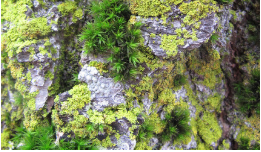
USDA | U.S. Forest Service
Hello, FamilIAAS!
Have you ever noticed moss growing on tree trunks, rocks, or damp soil and simply thought of it as another small plant? What if these tiny green organisms could tell us something about the environment around us? As environmental changes become increasingly difficult to observe with the naked eye, nature itself can provide subtle signals and mosses may be one of them.
Mosses are tiny, non-vascular plants that grow on land and are part of the bryophyte group, which also includes liverworths and hornworths. Unlike vascular plants, they don’t have real roots and don’t have special tissues like xylem to carry water around. Instead, mosses have structures that look like leaves called rhizoids that help them attach to their substrates. They commonly found in damp environments, although some species can survive in harsh habitats such as deserts and tundra. Mosses also have sporophyte, which produces spores, but it remains attached to the gametophyte and receives nutrients from it. In other words, the gametophyte is the main and more independent stage of the moss life cycle, while the sporophyte depends on it for development. This life cycle is different from that of many vascular plants and helps explain why mosses remain closely connected to their surrounding environment.
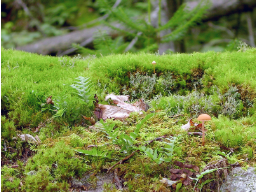
Our Habitat Garden | Janet Allen
Interaction with the environment is particularly important because mosses obtain water and nutrients largely through their exposed surfaces rather than through true roots. Their lack of a standard vascular system and protective structures also means that substances from their surroundings can interact directly with their tissues. As a result, changes in environmental conditions can influence their growth, distribution, vitality, and chemical composition. These biological characteristics make mosses more than passive inhabitants of an ecosystems, they can also respond to changes existing around them.
This is where mosses become valuable as natural bioindicators. A bioindicators is a organism whose presence, absence, condition, biological response can provide information about environmental conditions. In mosses, researchers can examine characteristics such as species distribution, abundance, vitality, and the substances accumulated within their tissues. Because mosses can interact directly with atmospheric deposition and their surrounding substrates, they have been widely studies as biomonitors of environmental contamination, particularly for heavy metals and other pollutants.
One of the most established applications is monitoring atmospheric pollution. Mosses can accumulate substances deposited from the atmosphere, including heavy metals and certain persistent organic pollutants. By analyzing moss samples collected from different locations, researchers can identify spatial patterns of contamination, and in some cases, changes over time, Moss biomonitoring can therefore complement conventional environmental monitoring methods, especially when large areas need to be assessed. However, the method is not without limitations, as factors such as species, substrate, climate, and sampling conditions can influence pollutant accumulation.
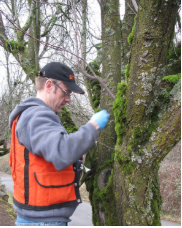
Moss sampling for air pollution monitoring | U.S. Forest Service
The ability to understand environmental condition through mosses also has relevance for agricultural landscapes. Agriculture does not exist independently from its surrounding environment, crop production is influence by air, water, soil, and the organisms that inhabit these systems. Mosses cannot replace direct measurements of soil, water, or air quality, but their presence and condition may provide additional ecological information about the landscape surrounding agricultural areas.
However, mosses should not be regarded as an independent tool for assessing environmental conditions. Their distribution and health may be influenced by various factors, such as moisture availability, light exposure, temperature, substrate properties, and characteristics specific to each species. In addition, pollutant accumulation may differ between locations and moss species, making careful sampling and accurate interpretations essential. Therefore, environmental assessment using mosses as bioindicators is most effective when combined with other environmental data and ecological information.
So, next time FamilIAAS finds a patch of moss growing quietly on a tree, rock, or area of soil, it shows that this small plant can be used as an early indicator whether the surrounding environment is still in good condition before further observations. Despite its simple appearance, moss interacts closely with its surroundings and can offer useful insights into environmental conditions. Sometimes, understanding the health of our environment does not require searching for something complicated. The clues may already be growing quietly all around us. (RAY)
Author: Raisah Mahira
References:
Baczewska-Dąbrowska, A. H., Gworek, B., & Dmuchowski, W. (2023). The use of mosses in biomonitoring of air pollution in the terrestrial environment: A review. Environmental Protection and Natural Resources, 34(2), 19–30.
Chaudhuri, S., & Roy, M. (2023). Global ambient air quality monitoring: Can mosses help? A systematic meta-analysis of literature about passive moss biomonitoring. Environment, Development and Sustainability, 26(3), 5735–5773.
Clark, M. A., Douglas, M., & Choi, J. (2018). Biology 2e. OpenStax. https://openstax.org/books/biology-2e
Printarakul, N., & Meeinkuirt, W. (2022). The bryophyte community as bioindicator of heavy metals in a waterfall outflow. Scientific Reports, 12, 6942.
Rajfur, M., Stoica, A.-I., Świsłowski, P., Stach, W., Ziegenbalg, F., & Mattausch, E. M. (2024). Assessment of atmospheric pollution by selected elements and PAHs during 12-month active biomonitoring of terrestrial mosses. Atmosphere, 15(1), 102.
Roblin, B., & Aherne, J. (2020). Moss as a biomonitor for the atmospheric deposition of anthropogenic microfibres. Science of the Total Environment, 715, 136973.